Saturday, September 28, 2013

Fort Sumter

When we stopped at the SC visitors' center for information about Charleston, we were overwhelmed.  Historic Charleston is a relatively small area built out from the wharf area, but there is stuff to see all around the bay in every direction.  There are a number of islands with stuff for everyone--history, architecture, shopping, eating.  Since we are learning our American history, we decided to start with Fort Sumpter.  The visitors center and fort are free to pass holders, but the ferry is $16 each.   
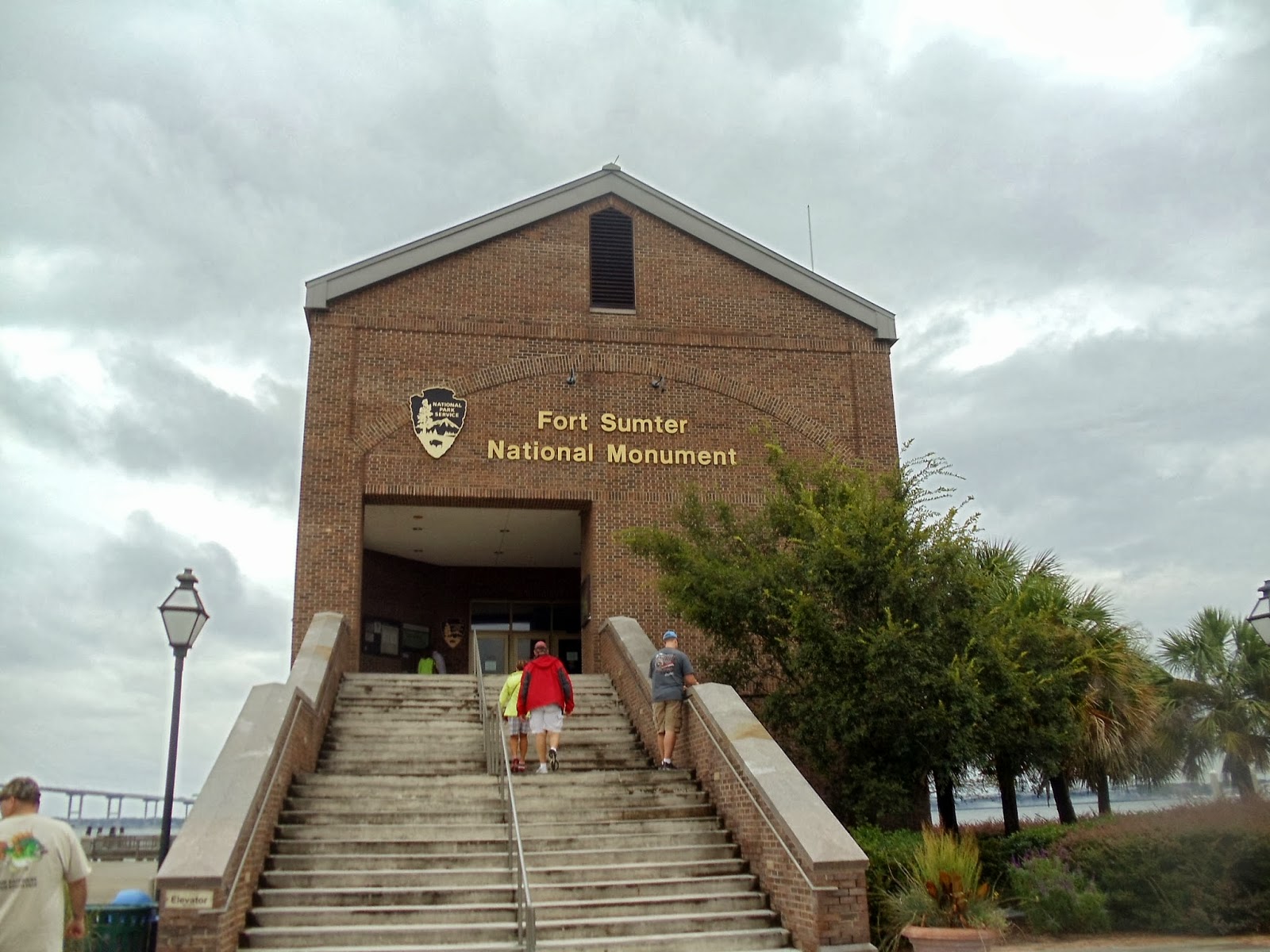


Fort Sumpter was begun in 1829, one of a series of coastal fortifications built by the US after the War of 1812.  The fort was constructed on 170 tons of east coast granite in the middle of the narrow mouth of the bay.  The fort was still unfinished when Maj. Robert Anderson moved his 85 man garrison into it the day after Christmas 1860, setting in motion events that would start the Civil War. Lack of manpower forced Anderson to surrender the fort and the Confederates took over.  With later reinforcements the Federal troops decided to bombard the fort from the other forts surrounding it.  The restored fort today bears little resemblance to the impressive work that stood there when the war began in 1861.  

During the decade following the war, the Army attempted to put Fort Sumpter back into shape as a military installation.  From 1876-1897 the fort was not garrisoned and served mainly as a lighthouse station.  The impending Spanish-American war prompted renewed activity that resulted in the reconstruction of Battery Huger in 1898 and the installation of more modern long-range canon. During WWI a small garrison manned the rifles (big guns) at Battery Huger.  For the next 20 years, although maintained by the Army, the fort was not used as a military establishment.  It did become a destination for tourists until WWII brought about the fort's reactivation.  The Battery Huger rifles were removed in 1943.  During late WWII antiaircraft guns were installed and manned by Coast Artillery.  In 1948, transferred from the War Dept. to the National Park Service, the fort became a national monument.  The fort today maintains the main historical portions of the fort.


After a short 15 min. history lesson, we were free to wander the fort for about an hour before reboarding the ferry.  The entire tour takes 2 hours allowing 30 min on the ferry each way.  The ferry is provided with restrooms, a snack area, seating inside and out.  A recording provides historical information about the fort.


Except for the American flag in the middle, the other flags show the succession of SC flags.


The submarine Hunley figured in the Civil War.  It is on display for touring, but like everyplace else in Charleston,  it charges its own fees.


These guns are huge and can shoot miles.


On our return ferry ride we passed this cruise ship being escorted out to see bytwo tiny Coast Guard boats.  They were small but their guns were manned.


We passed the retired aircraft carrier Yorktown which is now a floating museum.


Our pilot maneuvering us safely into dock.


We arrived at Ft. Sumpter site too early for our tour so we filled up our parking meter (city parking garages do not allow motorcycles) and walked down the street to a locally recommended deli for a pricey but good sandwich, then back for a view of the displays in the visitors' center.  After our tour we took time for a visit to the local H-D store, which turned out to be rather large.


The bikes on the wall are show bikes.

Tired and hungry, we hopped the bike for home.  Next, we tour one of the islands and see some of historical Charleston.

Later,

Louise and Duane

Wednesday, September 25, 2013

Capital City Bike Rally

Our stay at the Thousand Trails park in Gloucester, VA. ended on Friday the 20th. We don't like to travel on the weekend so we headed south to Wilson, NC. to the Kampers Lodge RV Park. It is a Passport America park that was only 150 miles south, a good stop for the weekend. When we got there I found out that the Capital City Bike Rally was going on in Raleigh, the capital city of NC. We planned on going to the rally on Saturday but woke up to rain and rain and rain. Sunday started out cloudy and cool. We suited up and rode the 50 miles to Raleigh. 
Ray Price, the owner of the sponsoring Harley dealer, was a drag racer for Harley. The second floor was a museum of race bikes and other memorabilia.  


When we arrived around 10 am there were hundreds of bikes lined up.

One of the race bikes

Drag bike

My favorite paint job

They had a stunt show going on. A lot of wheelies


This bike drew a lot of attention.


A balloon motorcycle hat
We spent 4 hours checking out the vendors and all the bikes. I bought a pair of sunglasses, a rally tee shirt and picked up the free HOG pin stop pin. Then it was back on the bike for the ride back to the rv. 

Monday, we headed on south to the Swamp Fox RV Park, another Passport America park. This place was fine for a night, but I can't recommend it for a longer stay. Tuesday, it was on to The Oaks Encore Park. We had a coupon for 50% off. We can visit Charleston, SC, Hilton Head and Savanna, GA from here. We will be here till next Monday when we move to the Jekyll Island State Park in Georgia for the month of October.
Stay tune for Charleston
Duane and Louise

Tuesday, September 24, 2013

Yorktown battle field and Victory Center

To complete our tour of the Historical Triangle, we spent the day at the Town of Yorktown, the Victory Center (museum), and the battlefield.  First we went to the battlefield which is maintained by the National Parks Service, so that our Pass got us in free.  There is a nice display explaining the significance of the battle, the last major battle of the American Revolution.  The formal surrender of the British under General Cornwallis to the combined Continental and French armies under Generals Washington and Rochambeau  took place in a private residence of a prominent Yorktown resident. 


The battlefield tour is a driving tour.  Cd's are available for auto tours.  At the building are the rebuilt earthworks the British threw up to deter the American forces after the British took Yorktown, a strategic harbor town, which is a short 400 yards or so to the west.  

These earthworks were rebuilt on the originals by the CCC.  The earthworks consisted of high mounds of dirt called redoubts lined with pointed logs to prevent access to the top where troops fired down on the enemy.  The removed dirt left trenches that protected the hills.  After the French navy stopped the British reinforcements from New York by sea, the French bombarded the earthworks with canon for three days before storming them and winning the battle. 


Memorial cemetery

The driving tour took us through forests to open fields where the troops were quartered.  At the time of the battle, there were no trees.  All of the area was a large plantation of planted fields, such as the one below.  At each area were historical markers to explain the significance of each stop.

The mound behind the sign is the only remaining original redoubt.  You have to imagine it without the trees and higher.

Memorial erected between the battlefield and the town.


Yorktown was established in 1691 by an Act for Ports passed by the Virginia House of Burgesses.  50 acres were purchased next to the York River and the town was surveyed into 85 half-acre lots.  By the early 1700s the town was a major port serving Williamsburg, the new capital of Virginia.  The waterfront was full of wharves, docks, storehouses, and businesses.  On the streets above the waterfront, stately homes of the wealthy merchants lined Main Street, with taverns and other shops scattered through the town.  Yorktown was a crowded town with 200-250 buildings.  The town reached its peak in the 1750's with a population of about 1800.  When tobacco, the source of the trade system and basis of much of the town's wealth, had exhausted the soil of nearby plantations, planters began moving westward.  Prominent families who would play important roles in Virginia during the Revolutionary War, still remained.  The siege of 1781 destroyed so much of the town that by 1790 there were less than 70 buildings, and the population reduced to 661.


On the hill, several houses and other structures from the colonial period are still standing and give the town much of the character of a long-vanished era. Down the hill at the riverfront, you will find modern restaurants and shops for tourists.  Although modern, they instill a feeling of a bustling center of commerce that once comprised the area.  


The bridge is the one we crossed every day to visit the Historical Triangle areas.  The bridge is free to enter the area, but charges a moderate toll to return.


We drove along the waterfront to access the Victory Center complex.  Complex is small, relatively speaking, but is currently under expansion.  The Complex is entered via the visitor entrance where tickets are purchased.  We were hungry but wanted to fit in this complex before it closed so didn't eat in Yorktown.  We found no food here but were directed to the vending machines where we cobbled together a lunch of sorts.  From the entrance we entered the small replica of a 1780's farm.  This was a mock up of what was usually a 200 or so self-sustaining farm of a middle-class family. It included a tobacco barn, small house, separate kitchen, crop field and vegetable and herb garden.  We were encouraged to wander at our leisure, talking to historical interpreters who demonstrated typical rural lifestyle during the nation's formative years.

Cooking would have been done by women.

This woman was picking seeds from cotton bolls.


Replica of a planted field.

After the farm we visited the Continental Army encampment.  This interpreter was explaining the tools and role of the camp surgeon.


Loading and shooting demo.

Field tents. (I used one of these when I was camping in the Fur Trade era and the War of 1812.)

After we roamed the encampment, we moved on to the museum.  It was up to our standards--very informative with great displays and easy to follow timelines.  Worth the entrance fee.  Of course no pictures were allowed.  To exit we had to return to the ticket center.  On the patio I was able to give  my approval of the Bill of Right to General Washington.

Not exactly on our way home--6 miles in the opposite direction--we took time to visit the local H-D shop and still made it home in time for supper.

That concludes our stay in Virginia and our tour of the local historical areas.  There were many more, but because of my bum ankle, we lost valuable touring time.  We hope to return some time for more.

See you in North Carolina,

Louise and Duane