Thursday, June 18, 2015

Genesee County Village and Museum

The weather remained clear so we took off on the bike for the Genesee County Village and Museum.  After a pleasant hour of scenic riding, we arrived at this extensive living history village.  The village consists of historic buildings moved from all over the area.  What makes this village different is that it is divided into three different time periods spanning a century and a half in time.  The self guided tour starts with three exhibition buildings outside the village with exhibits spanning the same time period. The first is the John L. Wehle Gallery.  Mr. Wehle is the reason that the village exists.  Inside is a collection of vehicles, paintings and sculptures depicting popular outdoor sporting events over the last century, including carriage driving for gentlemen, big game hunting, trophy fishing. 

This carriage is called a four in hand because the four reigns controlling the four horses are all held in one hand.  Gentlemen could prove their prowess by driving at a trot through the park or "drag" racing on the street.  I guess it could be compared to the difference between a chauffeur driven car and a gentleman driving his sports car. 


Scattered around the lawn in front of the gallery are several life-sized and life-like sculptures--mountain lion


bears

a flock of turkeys presided over by this beautiful male


The Exhibition Barn featured a collection of fabrics and clothing, some hand made, some manufactured.  This particular exhibit displayed clothing described in popular literature such as The Legend of Sleepy Hollow, Sherlock Holmes, Tom Sawyer, etc.  A fan of vintage fabric and clothing, I spent a lot of time in here.


The third building was the carriage museum, but the floor was empty.  The smaller gigs and sleds were suspended from the ceiling and difficult to photograph.  We suspected that more work was in the offing.  
After these three buildings, we actually entered the first part of the village, the Pioneer Settlement dating from the 1780's through the 1830's.  The buildings here were smaller, more primitively finished, and the business providing the necessities such as farm school, blacksmith, brewery.


This is a sparsely furnished blacksmith shop with only 20 or so pairs of tongs, and 5 or 6 hammers. 


Next was the Antebellum Village with a time period of 1830's-1860's.  With the completion of the Erie Canal, trade goods are more easily accessible so that houses are nicer and more comfortably furnished.

This dining room features a hearth with a beehive oven--the front is the little square on the right.


This kitchen is very large and modern with a built in laundry tub on the right, an ironing board and the back of the beehive oven in addition to the kitchen hearth, and sink.


This general store is able to provide a wide variety of dishes, spices, hardware etc. in very nice displays.


Any guesses?  
This is a horse or carriage mount.  Also note the sidewalk.

Other business included this gunsmith's shop, pottery shop, drug store, dressmaker's shop, printing office, and boot/shoemaker.  Personal services included offices for a physician, lawyer, insurance salesman, and a couple of churches.


Most building were not painted on the outside during this time period but log houses were covered with some kind of siding.  The village also featured an orchard, and a village square.
.


The Turn of the Century Village was small but accurately demonstrated the 1870's through 1920's.  This was an age of enlightenment with printed books bringing in new ideas and innovations in.  

The Hyde's were very modern in their thinking.  They believed in spiritualism and made their house in an octagonal so that evil spirits could not hide in the corners.  The houses of this time period were as large as incomes allowed with modern conveniences/innovations such as running water and an ice box in the kitchen, wall-to-wall padded carpet, flocked wallpaper, paintings, sculptures, gas chandeliers, modern appliances etc. all shipped by railroads and carted over improved roads. 


The grounds around this house also held a carriage house, ice house and a windmill.

Reproduction quilt and crocheted coverlet in traditional designs.
Notice the wallpaper and window shades.


We quite enjoyed our day long ramble through history.  We would rate this as a must-see if you are in the area.  Some of the buildings were not open for view for various reasons, but all in all the village was very enjoyable.  A few of the buildings were "repurposed".  A couple held info-board displays.  A couple provided food and drinks.  We very much appreciated these as we didn't bring any and the day was rather warm.  This village was our last scheduled place to visit.  Hopefully we will get in a bike ride or two. 

Stay tuned! 
 Louise and Duane 

Wednesday, June 17, 2015

Niagara Falls and Fort Niagara


Welcome to Niagara Falls on the American side!  We visited the Canadian side a few years ago and decided to complete the visit today.  This is a nice view of all three falls--Horseshoe  in the veil of mist continues around to the left and is hidden by Bridal Veil with American in the front.


View of the Maid Of The Mist boat ride.  The American side of the business dresses its passengers in blue plastic serapes, the Canadian side in red.  There are tons of family and adult oriented activities in both areas, with package tours keeping the prices within tourist budgets.  We opted for a walk around the free observation areas.


Rainbows in the mist


A view upriver of the falls with the pedestrian/bike bridge to Goat Island.  There is a car bridge beyond that.


View from Goat Island of where we were standing across the river.  Now the American Falls are in front.  The people at the bottom are looking over Bridal Veil.  We were there too.  The city of Niagara Falls  is in the distance.


Each fall makes its own mist rainbows depending on the sun's position.  We were done enjoying this tremendous river--its beautiful clear green waters and its tremendous roaring--so we walked back to the bike for a short ride to our next stop.


Just outside the town of Youngstown (Ohio people remember we are in New York), is the old Fort Niagara.  The history of the fort spans more than 300 years.  During the colonial wars in North America a fort at the mouth of the Niagara River was vital, controlling access to the Great Lakes and the westward route to the heartland of the continent.  During its history the fort was held by three nations--France, Great Britain, and the fledgling rebel colonial America.  Each country added to the fort.  This entrance to the fort was built by the French and named the Gate of Five Nations in honor of the Five Nations of the Iroquois Confederacy whose favor they were courting.


The French Castles the first building of the fort and  the oldest building in North America's Great Lakes region.  It was called the House of Peace to fool the Iroquois.  It was actually a fully equipped fort.


View from the wall.  The British built Fort George across the river somewhere in the vicinity of the trees.


No explanation necessary.


My blacksmith couldn't resist a photo of the hand-forged hardware.  I liked this because of the long skinny curly piece.  Click to enlarge it.  Its a rattlesnake!


This blacksmith shop is new (2010)  There is no information about a forge in the fort, but the ironwork came from somewhere.  Duane had a nice chat with the apprentice.  Another "new" building (not pictured) is a log cabin intended to represent  one originally built by the French in 1757.  It is used as a food concession (thank goodness for that--we were hungry!) with the proceeds going toward keeping the fort open.


View of Toronto (Canada)  Click to enlarge.  This was taken from the Rush-Bagot Memorial which was built in 1934.  It is named for the chief negotiators of an early armaments agreement signed by the United States and Great Britain in 1817 to limit naval forces on the Great Lakes.  Because of it today we enjoy a 4000 mile unfortified United States-Canadian border.


The flags of the three nations.


There was not much info about this lighthouse, one of the original gas lit ones.  The lite was originally at the top of the French Castle and moved here much later.  We love old lighthouses, but unfortunately this one was closed to the public.  

We had a wonderful day learning about our country's rough beginnings and viewing some of her most stunning scenery, but we were tired and turned out bike toward home.

We have one more site we want to visit in this area and some scenery-seeing bike rides, but those plans will depend on the weather.  Keep checking for further adventures!

Louise and Duane  

Tuesday, June 16, 2015

I'm back

I promise I will try to better with the blog.  We sat in Congress, Arizona at NorthRanch RV park while we work there for 5 months. Not a whole lot going while we were there. I played a lot of pickleball and took a lot of day trips on the bike.
We left Congress in March and headed to Texas to visit our three boys and their families that lived there. I also thought I had to take another driver's test because of the size of our truck. I made the appointment, I had to wait 3 weeks to get in. When I got there and the lady looked at all the weigh info on our trailer and truck I was told I did have to take the test. THREE weeks  wasted, oh well.
We enjoyed visiting with all the kids and grand-kids. We got to meet Jesse's girl friend and her daughter.
Leaving Texas, we headed to Rend Lake in Illinois for a week of rest. While there we made several bike trips. Then it was on to Ohio. Our two daughters still live there. One in Cincinnati, the other in Troy. While in the Dayton area we caught with a lot of friends and family. For two weeks it was run, run, run. Many days we would have lunch with someone and dinner with someone else. Rachel and Benji have three kids so it was ball games most evenings. Leaving Troy, we stopped at Mogadore, Ohio to visit a lady that Louise worked with years ago. On to Jefferson, Ohio where we stayed at a Thousand Trail campground for a week to rest up.
Monday we moved to Lockport, New York Elks Club. We chose Lockport for it's location. It's an easy ride to Niagara Falls, the Erie Canal, Fort Niagara and the Genesee Living History Park. Today was spent at the Erie Canal Locks.
The Erie Canal is a canal in New York that originally ran about 363 miles (584 km) from Albany, New York, on the Hudson River to Buffalo, New York, at Lake Erie. Built to create a navigable water route from New York City and the Atlantic Ocean to theGreat Lakes, the canal helped New York eclipse Philadelphia as the largest city and port[1][2] on the Eastern Seaboard of the United States. The canal is now part of the New York State Canal System.
First proposed in 1807, its construction began in 1817. The canal contains 36 locks and a total elevation differential of about 565 feet (172 m). It opened on October 26, 1825.
                                                 We visited locks 34 and 35 today. 

The lift of the two locks are 50 feet.


After wandering around this area we went home for lunch, then went back to town to visit the Niagara Historical Society Museum.  This was a complex of 4 buildings--two large historical houses, one small one and a large barn.  The exhibits showcased the life, times and business that made the original town of Lockport.  After a couple of interesting hours, we were done touring for the day.

Tomorrow we head to Niagara Falls and Fort Niagara.

Till next time
Duane and Louise

Monday, February 09, 2015

Finally something to blog about

We have been working here at the park and have not done anything to to blog about. Our days consist of  working, 2 days a week, and playing a lot of pickleball. On the days I don't work, I go to the court at 7:30 AM and play till about 9 AM. I return to the court at 1 PM and play for a couple of hours. Louise goes to the court at 4 PM for about 2 hours of playing. Did I mention that I love the game.... We are nearing the end of our commitment here at North Ranch RV Park. We will leave here the end of February. 
We decided that w had better get busy and do the things that were on our list to do here before we had to leave. So this past Thursday we climbed on the bike and took off for Oatman, Arizona.   Oatman is a small mining town on old route 66 that reinvented itself  as a tourist trap. After the mines closed down it about turned into a ghost town. Now it is a famous destination along old 66 known for the wild burros that roam the streets looking for hand outs from the visitors. 

The road into the town winds through the mountains along old 66 with few guard rails and a lot of tight turns. 


Did I say a lot of tight turns


As soon as you get into the town, it is apparent what the attraction to the town is. The burros are all over the place. These burros are descendents of  the burros that were used in the mining operations of the area and were turned loose to fend for themselves. They are protected by the Wild Horse Act and are free to roam where they want. Some of the stores in town sells food to feed them. They have become very good at begging and seem to be quite tame.

The town is a destination for a lot of people including a lot of bikers.
 The red one is ours.


 The hotel is famous for the fact that Clark Gable and  Carole Lombard spent their honeymoon there. Gable returned there often to gamble with the miners.
 The stores in town are the typical tourist town gift shops selling tee shirts and knick-knacks. 
 We spent several hours walking around Oatman and going in and out of the stores. We ate lunch while there. 

When we were done touring the town we mounted the bike and took off for Lake Havasu City, Az. 

The city is on the shores of Lake Havasu and has grown into a winter destination for a lot of snowbirds. The city has a lot of motels and restaurants to choose from. We arrived in town about 4:30 in the afternoon and got a room at a Super 8 Motel. They only had one room available and only for one night. Luckily that was all we needed it for. We went out to eat at a Black Bear restaurant and returned to the room for the night.  We had to stop at the Harley store while out.

Friday morning we took off to tour the town.  The main attraction in town is the London Bridge.

The 1831 London Bridge was the last project of engineer John Rennie and completed by his son, John Rennie the Younger.[3] By 1962, the bridge was not sound enough to support the increased load of modern traffic, and was sold by the City of London.
The purchaser, Robert McCulloch, the chairman of McCulloch Oil Corporation, was the founder of Lake Havasu City, his retirement real estate development on the east shore of Lake Havasu, a large reservoir on the Colorado River. McCulloch purchased the bridge to serve as a tourist attraction to Lake Havasu, which at that time was far from the usual tourist track. The idea was successful, bringing interested tourists and retirement home buyers to the area.
 When one thinks of lighthouses, they rarely consider a landlocked state covered in desert like Arizona for their location, but it just so happens that Lake Havasu City is home to more lighthouses than any other city in the entire country. These 1/3 scale replicas are actual functioning navigational aids built to the specifications of famous East Coast, West Coast and Great Lakes lighthouses. More than eighteen can be seen on the shores of the lake. Most can be hiked to while some are only accessible by boat.
 Early afternoon we headed off for home. The scenery south along the lake  is really rugged and ever changing. 
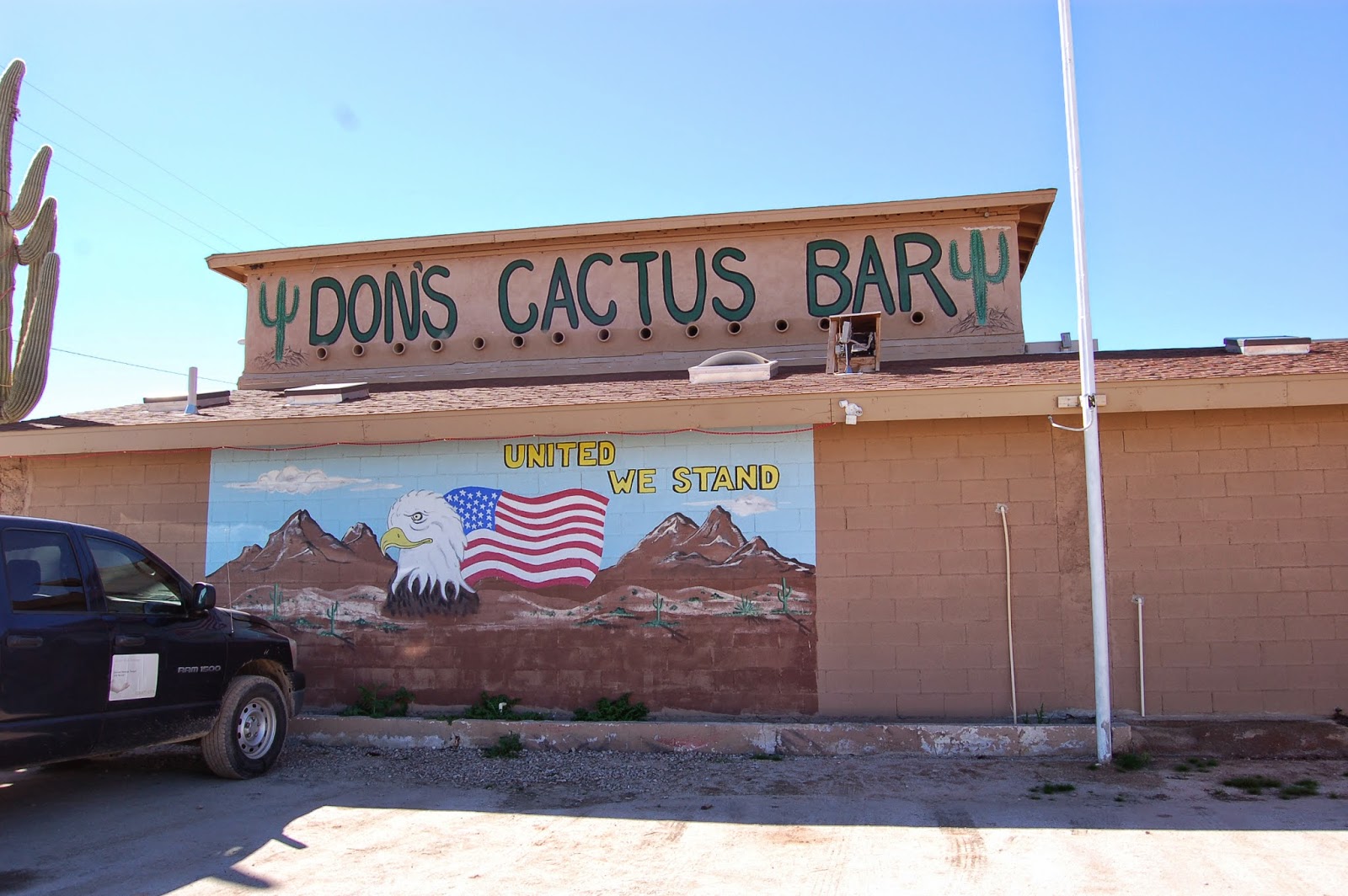
 We made a stop for a late lunch on the way home at Don's Cactus Bar. I had read that this is a popular stop for the biker clubs out of Phoenix. The food was pretty good.
We arrived home about 4 PM in time for a game of pickleball. We had a great time and saw some places that were on our list of places to see. We hope to find time for one more road trip before we leave here. 
Stay tuned to see if we make it.
Til next time
Duane and Louise